

← Back to Blogs
March 20, 2026

Dubai Property Investment 2026: Why the Smart Money Is Still Flowing In

By Joseph Toubia | RERA Certified Agent | Astra Terra Properties
Dubai Property Investment 2026: Why the Smart Money Is Still Flowing In

Dubai Property Investment 2026: The Case for Smart Capital

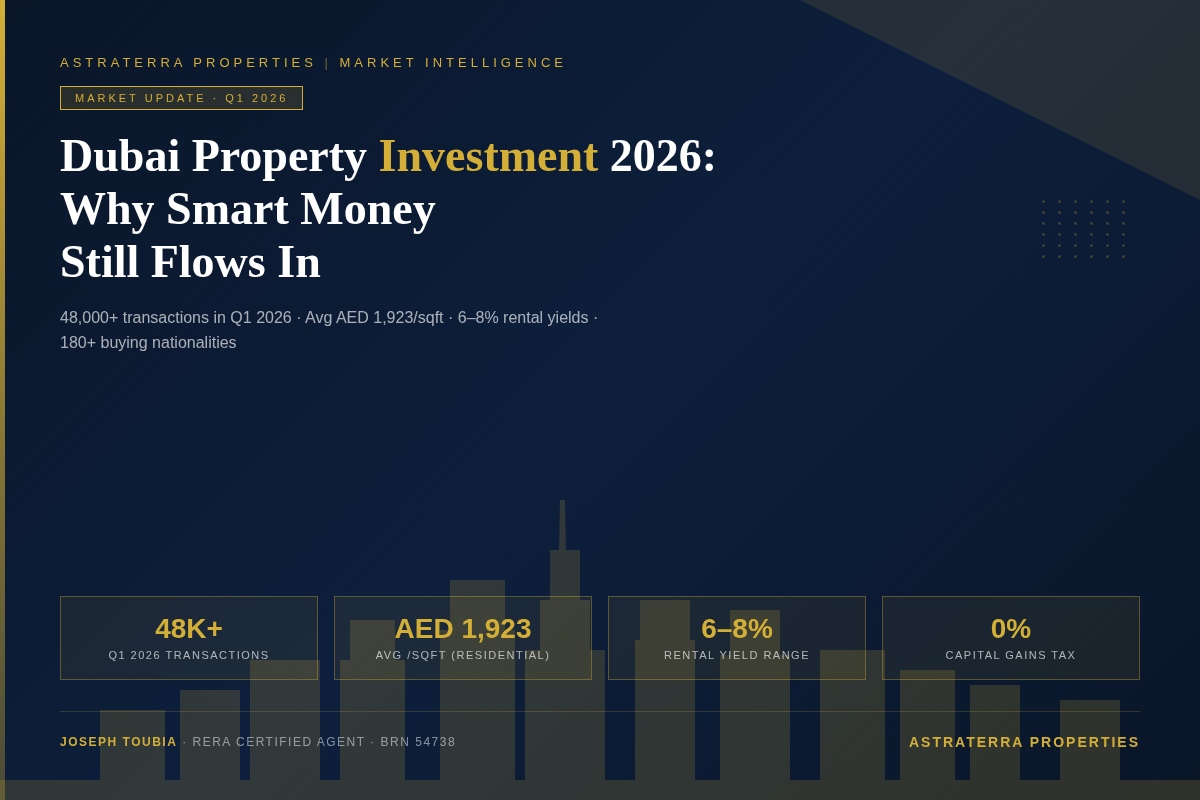
Dubai property investment 2026 continues to attract record capital despite global uncertainty — and for investors who look beyond the headlines, the data paints a compelling picture. Dubai recorded approximately 48,000 real estate transactions in Q1 2026, a 6% year-on-year increase, with average residential prices reaching AED 1,923 per square foot (Reliant Surveyors, March 2026). Off-plan apartments averaged AED 2,109/sqft, up from the December 2025 citywide average of AED 1,689/sqft. This is not a market running out of steam — it's a market maturing with momentum.

This guide covers the real case for Dubai property investment in 2026, where specific opportunities lie, and the contrarian analysis that most articles skip.

Dubai Property Investment 2026: What the Real Data Shows

The citywide AED 1,923/sqft figure conceals wide variance that matters enormously to investors. In Q1 2026, Palm Jumeirah recorded AED 3,200–4,500/sqft (up 15% YoY). Dubai Marina sits at AED 1,800–2,400/sqft (up 12%). Business Bay reached AED 1,400–1,900/sqft (up 10%), while Dubai Hills Estate recorded AED 1,600–2,200/sqft (up 13%). At the more accessible end, Jumeirah Village Circle averaged AED 900–1,200/sqft — up 8%, but with supply pressures building.

The 48,000+ Q1 2026 transactions were driven by strong international investor flows, with buyers from India, Russia, China, and the UK leading the roster — joined by increasingly active Western European investors priced out of their domestic markets by negative real yields and heavy transaction taxes.

These are the macro numbers. But the more important story for investors is at the micro-location level.

The 5 Core Pillars of Dubai Property Investment 2026

1. Zero-Tax Advantage — Still Unmatched Globally

Dubai offers 0% capital gains tax, 0% rental income tax, 0% annual property tax, and 0% inheritance tax. A property generating AED 200,000/year in rental income is kept in full by the Dubai investor. A comparable UK buy-to-let investor would lose 20–40% to income tax. Over a 10-year investment horizon, this differential compounds dramatically and represents tens of thousands of AED in additional after-tax return for Dubai investors.

2. Rental Yields Benchmarked Against Global Peers

In 2026, Dubai delivers 6–8% gross rental yields across most asset classes. Al Furjan studios hit 8.51% gross yield, JVC studios 7.87%, Downtown Dubai studios 7.92%, and Dubai Land Residence Complex (DLRC) apartments approximately 9% in newer developments (Engel & Völkers UAE, 2026). By comparison, prime London yields average 3.2%, Manhattan 3.5%, and Singapore prime residential 2.8–3.5%. For income-focused investors, Dubai is in a fundamentally different category.

3. Capital Appreciation in Prime and Emerging Zones

Dubai Hills Estate recorded 13% YoY appreciation in Q1 2026. DAMAC Lagoons hit 14% YoY growth on the back of Al Maktoum Airport expansion projections. Business Bay's transformation from a pure commercial zone to a premium live-work-play destination — led by Opus Residences by Zaha Hadid on Marasi Drive and Millennium Binghatti Residences — is generating both rental yield and strong capital gain for early holders.

4. Golden Visa: The Dual Asset Nobody Fully Prices In

The AED 2M property threshold for a 10-year UAE Golden Visa means buyers are getting a dual return: income or capital gain PLUS UAE residency. Over 12,000 Golden Visas were issued via the property route in 2025 (RERA 2025 data). For wealth management clients and international families, this residency optionality can be worth as much as the financial return itself — access to UAE banking, schooling, healthcare, and business formation in a zero-income-tax jurisdiction.

5. Off-Plan Payment Plans That Democratise Access

Over 60% of Dubai transactions in Q1 2026 were off-plan. Developers are offering post-handover payment plans (PHPPs) where buyers pay as little as 5–10% on booking. At Sobha Hartland II in Mohammed Bin Rashid City, structured 80/20 plans allow investors to commit with minimal upfront capital. At DAMAC Lagoons Phase 2, 1% monthly payment structures are available. This creates leverage that simply doesn't exist in London, New York, or Sydney markets, where full purchase prices are required at exchange.

Dubai Property Investment 2026: Where Smart Capital Is Moving

Dubai Creek Harbour (Ras Al Khor Road corridor) is generating 7–8.5% gross yields on completed units (PropertyFinder January 2026). Emaar's ongoing Phase 2 launches at Harbour Views I & II and Creek Edge mean early-phase buyers are sitting on 25–35% unrealised gains. The confirmed metro line to Creek Harbour for 2027 adds structural upside to subsequent phases.

Al Furjan (Sheikh Mohammed Bin Zayed Road corridor) — Azizi Aura, Azizi Star, and adjacent developments are recording 8.2–8.7% gross yields on 1BR units in Q1 2026. Al Maktoum International Airport's projected 260 million passenger capacity target is the structural tailwind that differentiates Al Furjan from other mid-range communities — it's an airport city in the making.

Jumeirah 1, 2, and 3 (Jumeirah Beach Road) — Villa investors are targeting villas along Jumeirah Beach Road and the La Mer waterfront for rental yields of 4.5–5.5%, with capital appreciation running at 10–14% YoY on ready product. Unlike Palm Jumeirah ultra-luxury, Jumeirah villas have an active, liquid secondary market with a diverse tenant pool including senior executives, diplomats, and extended-stay visitors.

Contrarian Analysis, Joseph's Take & Investment FAQs

Dubai Property Investment 2026: The Contrarian View on JVC and Oversupplied Pockets

The most important contrarian argument in Dubai property investment 2026 is about Jumeirah Village Circle. From 2021 to 2024, JVC was the default recommendation for budget investors: AED 550K for a 1BR, 7.8% yield, fast lettings. That thesis delivered well — the data confirmed it.

But the 2026 supply pipeline changes the analysis. JVC has over 15,000 apartments under construction scheduled for delivery between 2026 and 2028. In Districts 14, 18, and portions of District 10, investors are already reporting void periods increasing from 14–21 days to 45–60+ days. New supply in a finite-demand zone creates a ceiling on both rent growth and capital appreciation.

The smart money in 2026 is not automatically buying in "proven" communities. It's running supply pipeline analysis, checking school catchments and employer bases within commuting range, and looking at infrastructure additions. On those metrics, Dubai Creek Harbour, Al Furjan, and Jumeirah Beach Road villa markets score better than oversupplied pockets — even if the brand recognition is lower. Brand awareness follows capital appreciation; it doesn't precede it.

Joseph's Take: What I'm Seeing on the Ground in Dubai in 2026

At Astraterra, we've seen a significant shift in our buyer profile through Q1 2026. Eighteen months ago, the typical inquiry was: "What's the cheapest entry point for a rental yield?" Today, it's: "Which location has the best 5-year supply-demand balance, and where do I get Golden Visa eligibility at the lowest cost of entry?"

That's a materially more sophisticated buyer. It reflects that Dubai is no longer a speculative bet for most buyers — it's a core allocation in diversified international portfolios, sitting alongside equities and gold for high-net-worth investors from India, Russia, the UK, China, and increasingly Western Europe.

The most interesting deal we facilitated in early 2026 was a family from Germany who purchased two units at Marina Gate 1 on Marina Promenade — a 1BR and a 2BR — through a 60/40 payment plan extended by Select Group. Total investment AED 3.2M, qualifying for Golden Visa, and generating projected AED 240,000/year in rental income at current market rates. Their alternative was a buy-to-let in Berlin at 2.5% yield with 15% CGT on exit. Dubai wasn't even a close comparison.

My direct advice for 2026: don't buy in areas with supply pipelines you haven't researched. Don't buy off-plan with developers who don't have a track record of on-time delivery — 17% of off-plan projects missed handover by 12+ months in 2025 (RERA). And don't assume cheapest entry point equals best return. In a maturing market, quality location and developer reputation beat price alone.

Disclaimer: This content is for informational purposes only and does not constitute financial, investment, or legal advice. Prices correct as of Q1 2026. Past performance does not guarantee future returns. Always conduct independent due diligence and consult a RERA-certified agent before making investment decisions.

Dubai Property Investment 2026 — Frequently Asked Questions

Is Dubai property investment still worth it in 2026?

Yes, based on current data. Dubai recorded approximately 48,000 transactions in Q1 2026, a 6% year-on-year increase, with average residential prices at AED 1,923/sqft. Rental yields average 6–8% gross, with zero capital gains tax and zero rental income tax. However, location selection within Dubai matters more than ever — oversupplied sub-markets are softening while prime and infrastructure-backed zones outperform.

What is the minimum investment amount for Dubai property in 2026?

Studios in communities like Al Furjan, JVC, and Dubai South can be acquired from AED 450,000–550,000. For Golden Visa eligibility, the minimum is AED 2,000,000 in a completed (ready) property. Off-plan properties with payment plans allow entry from 5–10% down, meaning an investor can secure a unit worth AED 1M with AED 50,000–100,000 initial outlay through developer financing structures.

Which areas offer the best rental yield for Dubai property investment in 2026?

Based on Q1 2026 data, the highest gross rental yields are found in: Al Furjan studios at 8.51%, JVC studios at 7.87–7.92%, Downtown Dubai studios at 7.92%, and Dubai Land Residence Complex (DLRC) apartments at approximately 9%. Dubai Marina mid-floor units on Marina Walk average 6.8–7.2% gross. Premium areas like Palm Jumeirah offer 4.5–5.5% yield but stronger capital appreciation potential.

What are the key risks in Dubai property investment in 2026?

Key risks include: (1) oversupplied sub-markets in JVC and parts of Dubai South; (2) developer track record failures — 17% of off-plan projects missed handover by 12+ months in 2025; (3) service charge erosion — ranging AED 8–20/sqft annually depending on community; (4) currency exposure for non-USD investors, as the AED is USD-pegged, meaning GBP, EUR, or INR returns fluctuate with exchange rates; (5) policy risk, though Dubai has maintained a consistently investor-friendly regulatory environment since 2002.

Ready to explore your Dubai property investment 2026 options? Contact Astraterra Properties for a personalised investment briefing. Our RERA-certified team provides data-driven, supply-pipeline-aware recommendations — not generic advice.

Astraterra Properties | Oxford Tower, Office 502, Business Bay, Dubai | BRN 54738 | ORN 44050

J

Joseph Toubia

Founder & CEO | RERA Certified Agent | Astra Terra Properties

Joseph Toubia is the founder and CEO of Astra Terra Properties, a full-service real estate agency headquartered in Business Bay, Dubai. With years of hands-on experience in the Dubai property market and RERA certification, Joseph specialises in helping buyers, investors, and tenants navigate the UAE real estate landscape with confidence.

📞 +971 58 558 0053✉️ info@astraterra.ae🌐 View Profile💬 WhatsApp Joseph

Ready to Invest in Dubai Property?

Browse our curated selection of off-plan projects with flexible payment plans from 10% down, or explore ready properties for sale across Dubai.

Browse Off-Plan Projects →Buy Ready Property →

More Insights

Back to All Blogs
Get Free Consultation