


← Back to Blogs
October 19, 2026

Updated 19 October 2026

The considered shortlist: a Dubai home-viewing scorecard

By Astra Terra Editorial Team | Astra Terra Properties
4 min read
The considered shortlist: a Dubai home-viewing scorecard

Start with the life the home must support

A beautiful entrance can make a viewing memorable. It cannot tell you whether the home will work on an ordinary Tuesday. Before comparing finishes, write down the routines the property must accommodate: your commute, working hours, storage, visitors and the way you use outdoor space.

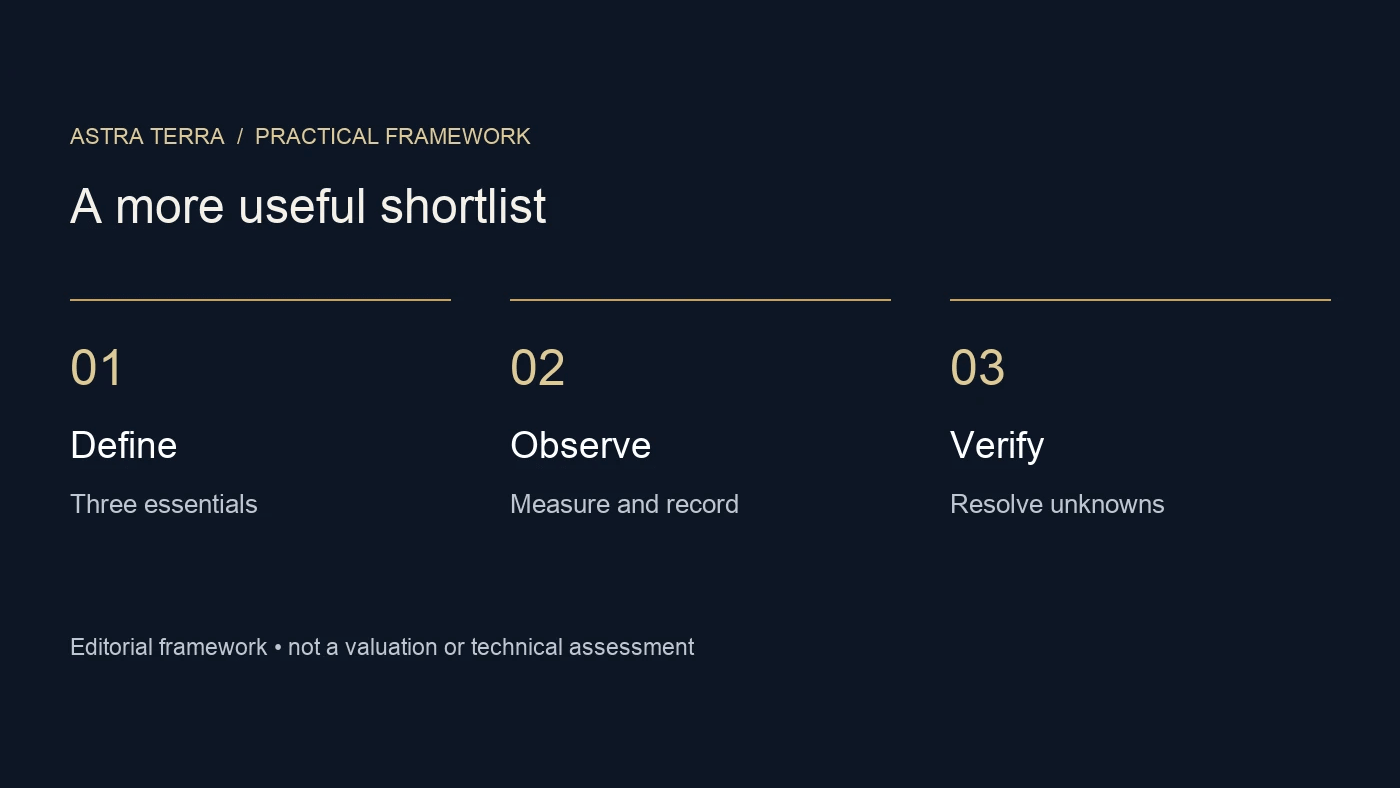
Keep three non-negotiables and three preferences. A non-negotiable should be a genuine reason to decline a property; a preference can be traded against price or convenience. This distinction makes a shortlist useful when two homes photograph equally well.

Editorial image note: The cover is an AI-generated architectural concept, not an available property or a photograph of a named Dubai building.
Read the market, then return to the individual home

Our Q3 2026 residential newsroom analysis examines a more selective market. Savills’ report, published on 12 October 2026, distinguishes changes in the mix of transactions from the behaviour of comparable properties. That distinction matters when an asking price is justified with a city-wide headline.

Use market reporting to frame questions, then ask for evidence relevant to the building, unit type, condition and transaction date. An asking price is a seller’s position. A completed comparable transaction is a different kind of evidence. Neither removes the need to understand the particular home.

Walk the route before you judge the room

Walk the route before you judge the room

Arrive as you would in daily life. Test the approach from parking or the drop-off point, the entrance, lifts and route to the apartment. Note steps, long corridors, visitor access and any bottleneck you can actually observe. Where access is important, revisit at a different time rather than assuming one quiet viewing represents the whole week.

Inside, trace the movement between entrance, kitchen, living area and bedrooms. Open doors and cupboards with permission. Check whether furniture can fit without narrowing circulation. Measure the walls that matter; a wide-angle photograph is not a room dimension.

  • Record usable space and awkward corners separately from the advertised area.
  • Observe daylight, privacy and noise with windows both open and closed.
  • Ask what can be inspected now and what requires a qualified specialist.

Astra Terra editorial decision framework; not a technical assessment.

Use a scorecard that keeps uncertainty visible

Rate each category from one to five against your own brief, using the same standard for every home. Add an evidence note beside every score. “Not checked” is a valid entry and should remain visible; it should never become an optimistic average.

CategoryEvidence to recordQuestion to resolve
Daily fitMeasured layout, storage, privacyWhich essential routine is compromised?
Building experienceObserved access and common areasWhat maintenance information is available?
Cost clarityWritten price and itemised estimatesWhich costs remain unconfirmed?
ReadinessCondition, occupancy and document statusWhat must happen before occupation?

A high total should not override a failed non-negotiable. The scorecard is a comparison tool, not a valuation, technical inspection or prediction of future returns.

Separate purchase price from the cost of owning

Prepare an itemised ownership budget rather than one headline number. Ask for current building charges and what they cover, expected maintenance responsibilities, utility arrangements and any known work requiring attention. Distinguish recurring costs, transaction costs and optional improvements. Seek current written quotations where amounts are material.

If financing is needed, discuss the specific property and your circumstances with the lender before making commitments. For a property still under construction, record the payment timetable, the documents supporting the offer and the uncertainty around completion and occupation. A show apartment demonstrates a design proposition; it is not an inspection of a completed unit.

End every viewing with the same three notes

Before seeing the next home, write down what worked, what did not and what remains unverified. Keep photographs only where permitted and label them with the correct property and date. Ask the agent for a written follow-up on missing information rather than treating an informal assurance as a completed check.

Your next decision may be to revisit, request specialist inspection, negotiate, broaden the search or decline. A smaller shortlist with clear evidence is more useful than a longer list held together by attractive photographs.

Explore properties for sale or share your buying brief with Astra Terra. Include your intended use, budget range, timing and non-negotiables so the discussion can begin with suitability.

Market context: Savills, Dubai Residential Market Report — Q3 2026, published 12 October 2026. This guide is an original practical framework; it does not provide legal, lending or technical advice.

J

Joseph Toubia

CEO & Founder, Astra Terra Properties

RERA-certified real estate professional (BRN 54738) specialising in Dubai off-plan properties, investment advisory, and Golden Visa guidance. Based in Dubai.

View full profile →+971 58 558 0053info@astraterra.aeWhatsApp Joseph

Ready to Invest in Dubai Property?

Compare off-plan project details, payment schedules and handover terms, or explore ready properties for sale across Dubai.

Browse Off-Plan Projects →Buy Ready Property →

More Insights

Browse off-plan properties → · Use our free calculators → · UAE Golden Visa guide →

Back to All Blogs
Get Private Shortlist + ROI on WhatsApp
Dubai Home Viewing Scorecard | Astra Terra