

📅 Published: August 26, 2026
Quick answer: if your office is client-facing, recruitment-sensitive or built around a 3-5 year operating plan, Grade A space is usually the smarter move. If your team needs speed, shorter commitment and lighter capex, a well-located Grade B or managed office can still be rational. The mistake is comparing only the headline rent and ignoring fit-out, downtime and exit flexibility.
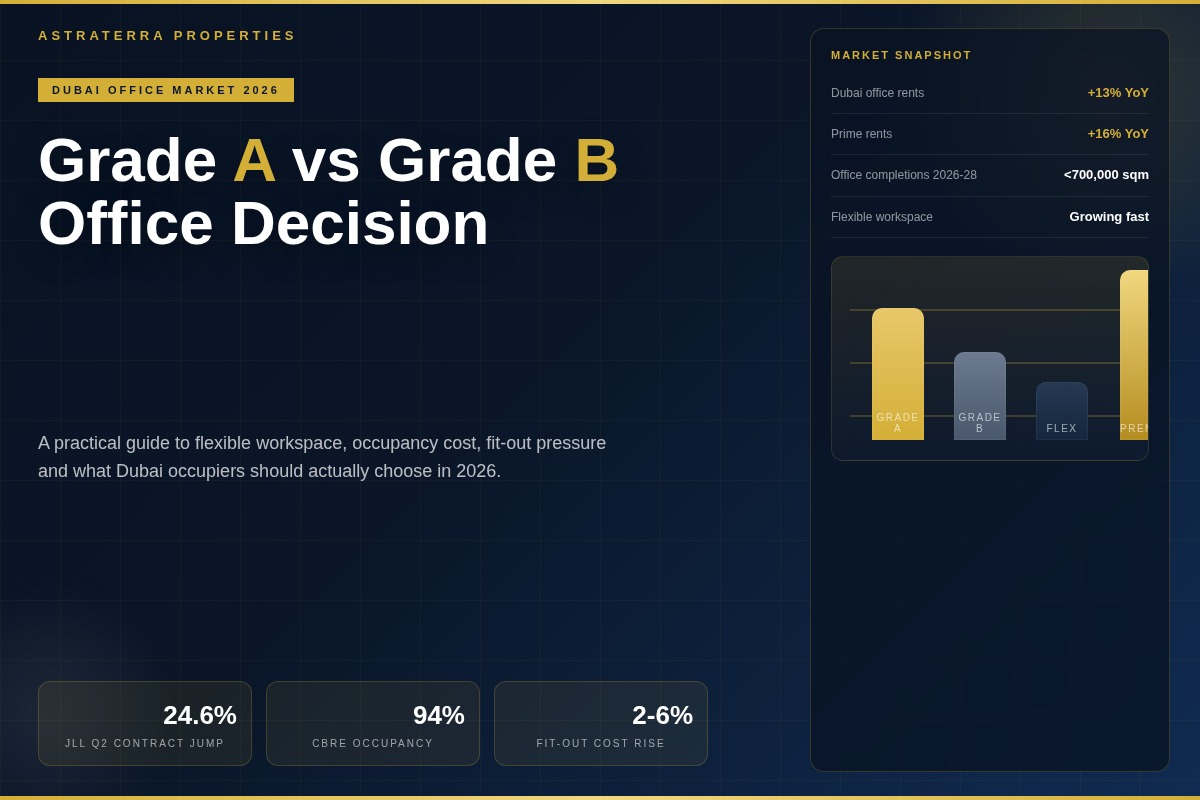
JLL’s UAE Office Market Dynamics, Q2 2026 says Dubai’s rental contract registrations jumped 24.6% year on year in Q2, driven primarily by new contracts. The same update says the flexible workspace segment continues to expand because companies want lower-risk alternatives with reduced capital requirements and shorter lease commitments. That is the core signal: occupiers are still active, but they want optionality. [Source: JLL UAE Office Market Dynamics, Q2 2026, Jul. 31, 2026]
CBRE’s UAE Real Estate Market Review Q2 2026 adds the price side of the story. Dubai office rents rose 13% year on year, prime rents were up 16%, and occupancy stayed at about 94%. In other words, the market is still tight enough that good space gets absorbed, but not so irrational that every lease is equal. When the market is supply constrained, location and specification stop being marketing language and become pricing power. [Source: CBRE UAE Real Estate Market Review Q2 2026, Jul. 28, 2026]
At Astraterra, we’ve seen exactly how this plays out with clients who start the search saying they want the lowest monthly rent, then realize that the lowest rent can become the most expensive option after fit-out, furnishing, delays and missed time-to-operation are counted. A polished office in DIFC, One Central or Boulevard Plaza can be more rational than an apparently cheaper unit in a less convincing building if it helps the business hire faster, win confidence and avoid a costly refit.
The contrarian bit is important. Grade B is not automatically a bad choice. In fact, for back-office teams, project teams and companies that do not need a premium client experience, a well-located Grade B office or managed suite can outperform a shiny Grade A tower on total occupancy cost. The point is not prestige. The point is fit.
That is why this 2026 office conversation is really a conversion conversation. If the workspace helps the team operate better, then the rent premium can be justified. If it only adds address value, it may not be worth the capex drag.
For the commercial side of the market more broadly, see our Dubai commercial property overview and current offices for rent in Dubai pages for live stock and market context.
Why Grade A is winning the cost conversation
The reason Grade A keeps winning is not that occupiers suddenly became snobbier. It is that the quality gap matters more when budgets are already stretched by fit-out, furniture, and tech. JLL’s 2026 Global Office Fit-Out Costs Guide says global fit-out costs have risen by 2% to 6% over the past year, and that 52% of markets reported slight increases in Q4 2025 while 48% saw little or no change. It also says fit-out costs can vary by 10% to 30% across different typologies and specifications. That is a wide enough range to change the answer on the lease decision. [Source: JLL Global Office Fit-Out Costs Guide 2026, Apr. 16, 2026]
Put simply, the asking rent is only one line in the spreadsheet. If a Grade A tower gives you better MEP, better lift performance, stronger lobby experience and easier client access, then the premium may be offset by lower remodeling friction and less operational waste. The office stops being just a cost center and becomes a business tool. That is particularly relevant for legal firms, wealth managers, family offices, consultancies and tech teams that rely on credibility the moment a visitor steps out of the lift.
The market is also showing that demand is not disappearing into home working. JLL’s flexible office research says only 3% of corporations globally use flexible space for more than 10% of their portfolio, which tells you there is still a huge amount of room for growth. The same theme appears in managed space research: JLL says managed deals account for 25% of flexible workspace transactions, with average deal sizes of about 6,600 sq ft, while nearly a quarter of organisations now commit to flexible workspace terms longer than 24 months. Flex is maturing into a real portfolio tool rather than a temporary trend. [Sources: JLL The Flexible Office Space Imperative, Apr. 14, 2026; JLL Managed Offices - from void to value, Jul. 8, 2026]
This is why premium buildings are not losing relevance. They are being repurposed. A Grade A building in DIFC, TECOM or DMCC can support a core headquarters, a satellite team or a managed suite strategy. That matters because JLL’s Q2 2026 Dubai office update says landlord strategy is still being shaped by timely completions and pre-lease commitments across many projects, while some assets are being refurbished to meet higher quality expectations.
For occupiers, the lesson is clear: quality is now a budgeting issue, not just a branding issue. If your team is going to live with the space every day, you should underwrite the office with the same discipline you would use for any other business-critical asset.
At a macro level, the supply backdrop still favours quality. CBRE says projected office completions across 2026 to 2028 are under 700,000 sqm and much of that is expected to be pre-let before completion, particularly in Dubai’s main commercial free zones. That means the better buildings keep their pricing power longer, while weaker space must compete harder on terms.
How to choose between Grade A, Grade B and flex
When Joseph asks clients what they actually need from an office, the answers usually collapse into four real variables: brand, people, capital and time. Once you strip away the marketing language, that is the whole game. A Grade A office makes sense when the business wants to signal stability, host clients frequently, and avoid the hidden costs of retrofitting a tired layout. A Grade B or managed office makes sense when the business wants speed, a shorter lease and a cleaner capex profile.
In Dubai, that difference shows up in location choice as much as in building grade. If you need a premium address with strong visitor flow, look at DIFC Gate Village, Boulevard Plaza, One Central, Index Tower or high-spec towers along Sheikh Zayed Road. If you want practical value and easier cost control, the smarter hunt may be in Business Bay, JLT, Barsha Heights or parts of TECOM and DMCC.
That does not mean Grade B is second-rate. A well-managed Grade B floor in the right building can be exactly what a brokerage, sales team or growing SME needs. The key is to understand what you are paying for. If the building gives you parking, decent lift times, reliable maintenance and good connectivity, then a lower headline rent can be a genuine advantage. But if the building looks cheap because everything else is cheap too, the savings can disappear in lost productivity and weak tenant morale.
Here is the simplest way we explain the choice to clients:
The most overlooked factor is downtime. Every week spent fitting out a new office is a week of distraction for leadership, operations and hiring. If a managed solution gets the team operational faster, it can be the better business decision even if the rent looks higher on paper. That is the logic behind the growth in flex and managed space: less upfront capital, less execution risk and more ability to adapt if headcount changes.
My practical rule is simple. If your office is part showroom, part sales engine, and part talent signal, buy quality. If your office is primarily functional infrastructure, buy flexibility. And if you are not sure which camp you are in, start with a shortlist in commercial property for rent in Dubai, then pressure-test the candidates against fit-out cost, lease term and the next 24 months of your business plan.
One more thing. The office market is not just about rentals. It is part of the broader commercial property stack. If you are comparing office space against shops or warehouses, the right answer can change quickly once you model the actual operating cost, not just the monthly payment. That is exactly why we keep our commercial advisory linked to live market data rather than static brochure pricing.
Frequently asked questions
Is Grade A office space always better than Grade B in Dubai?
No. Grade A is usually better for client-facing or people-sensitive businesses, but Grade B can be smarter when the business wants lower rent, a shorter commitment or a lighter capex burden. The right answer depends on what the space has to do for the business.
Does flexible workspace still make sense in 2026?
Yes. JLL says the flexible workspace segment continues to expand in Dubai because companies want lower-risk alternatives with shorter lease commitments and reduced capital requirements. The sector is still underpenetrated globally, which is why there is room for more growth.
Which Dubai office locations are strongest right now?
The premium side remains strongest in areas such as DIFC, One Central, Boulevard Plaza and the best parts of Sheikh Zayed Road. More value-driven occupiers often look at Business Bay, JLT, TECOM, Barsha Heights and DMCC, where the trade-off between rent and practicality can still work.
Why does fit-out cost matter so much?
Because the fit-out is often the hidden second lease. JLL says global office fit-out costs have risen 2% to 6% over the past year, and typology differences can swing 10% to 30%. If you ignore that line item, you can choose the wrong office on paper.
What does the Dubai supply pipeline mean for occupiers?
CBRE says projected office completions from 2026 to 2028 are under 700,000 sqm and much of that is likely to be pre-let. That keeps pressure on the better buildings and supports the case for acting early if you find the right space.
How should a business decide between flex and a traditional lease?
Use flex if you want speed, less capex and more optionality. Use a traditional lease if the business is stable, you want control over the brand experience, and you are comfortable absorbing the cost of a longer fit-out and longer commitment.
If you want us to shortlist offices for your team, start with your budget, headcount, preferred districts and lease term. We can then filter the market against total occupancy cost, not just the advertised rent. That is usually where the real value shows up.