
Dubai is no longer a one-track property market where every buyer wants the same thing. In 2026, the city is splitting into two very different buying behaviours. One group is still looking for efficient, liquid, income-producing apartments. The other wants more space, more privacy and a home that works for school runs, family routines and long-term living. That split matters because the wrong choice can look good on paper and still feel wrong after the first year.
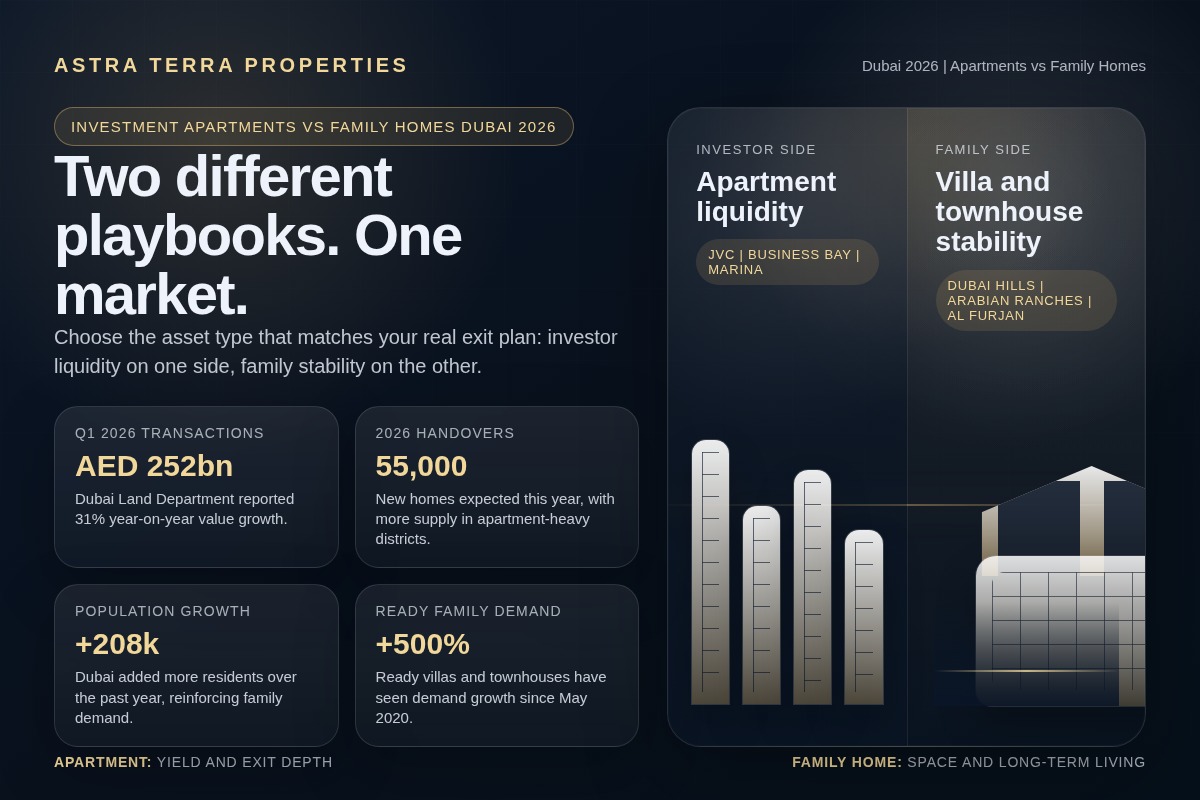
The macro numbers show why buyers have to be more selective. Dubai Land Department said Q1 2026 transactions reached AED252 billion, up 31 percent year on year, while investments totalled AED173 billion across 57,744 transactions. That is strong demand, but it is not random demand. Buyers are becoming more segmented, more data-led and more willing to choose based on purpose instead of chasing the same headline story.
From the agent's desk at Astra Terra Properties, the question is never simply apartment or villa. The real question is whether the buyer is underwriting yield, liquidity, space or stability. If you want the upside side of the broader market first, our Dubai property market H2 2026 outlook is the right companion piece. If you want the lifestyle side of the city, compare this with our waterfront premium analysis.
Joseph's take: the most expensive mistake in Dubai right now is not buying the wrong neighbourhood. It is buying the wrong asset type for the way you actually plan to use the property.
Why Apartments Still Win The Investor Math
Investment apartments remain the cleaner play for buyers who care about liquidity and easier exits. They usually cost less per ticket, are easier to rent quickly and appeal to a broader tenant pool than larger family homes. In a city where many investors want flexibility, that matters. Apartments also tend to fit the short- to medium-term buyer who may want to upgrade, refinance or rotate capital faster than a family home usually allows.
The 2026 supply pipeline reinforces that apartment selection has to be deliberate. Khaleej Times reported that around 55,000 homes are expected to be handed over in 2026, and another report noted that nearly 45 percent of under-construction stock sits across JVC/JVT, Dubai South, MBR City, Business Bay and Dubailand Residence Complex. The same source said about 66 percent of upcoming supply is studios and one-bedroom units. That does not kill apartment demand, but it does mean small-unit investors need to be more selective about building quality, view, transport access and rental depth.
That is why the best apartment plays in Dubai are rarely the same across the market. JVC still works for value hunters and young tenants. Business Bay and Dubai Marina still work for rental depth and corporate convenience. Dubai South can work when the buyer is early and patient. In each case, the apartment is not just a home; it is a trading instrument. The job is to buy the asset that is easiest to explain to the next buyer or tenant.
The current market also gives apartments a tactical edge. Khaleej Times reported that in Q2 2026, average apartment and villa sale prices both eased 3 percent quarter on quarter, while apartment rents fell 4 percent and villa rents fell 2 percent. That kind of reset can open better entry points for disciplined investors, especially in buildings where the tenant demand is real rather than speculative. It is also why we keep telling clients to compare buildings, not just districts.
For a practical example, a one-bedroom apartment in JVC can make sense if the buyer wants steady rental interest and a simple exit, while a two-bedroom unit in Business Bay can suit a buyer who wants stronger corporate tenant demand and better centrality. The apartment playbook is not about romanticism. It is about precision.
Why Family Homes Win For Stability And Daily Life
Family homes win when the buyer is no longer thinking like a trader and starts thinking like a resident. That is where villas and townhouses create a different kind of value. They offer more privacy, more storage, bigger kitchens, better outdoor space and usually a more comfortable long-term life for families with children. In Dubai, those lifestyle advantages are not soft perks; they are part of the value proposition.
The demand data keeps pointing in that direction. DLD's Mo'asher release showed ready-to-move-in villas and townhouses had grown by more than 500 percent since May 2020, and the same article highlighted 665 ready villa/townhouse transfers in October 2020 as a record-breaking month. More recently, Khaleej Times reported that long-term residents are upgrading from smaller apartments to larger units and villas, reflecting Dubai's evolution into a long-term residential hub rather than a transient market. That shift matters because it means family-home demand is not just emotional. It is structural.
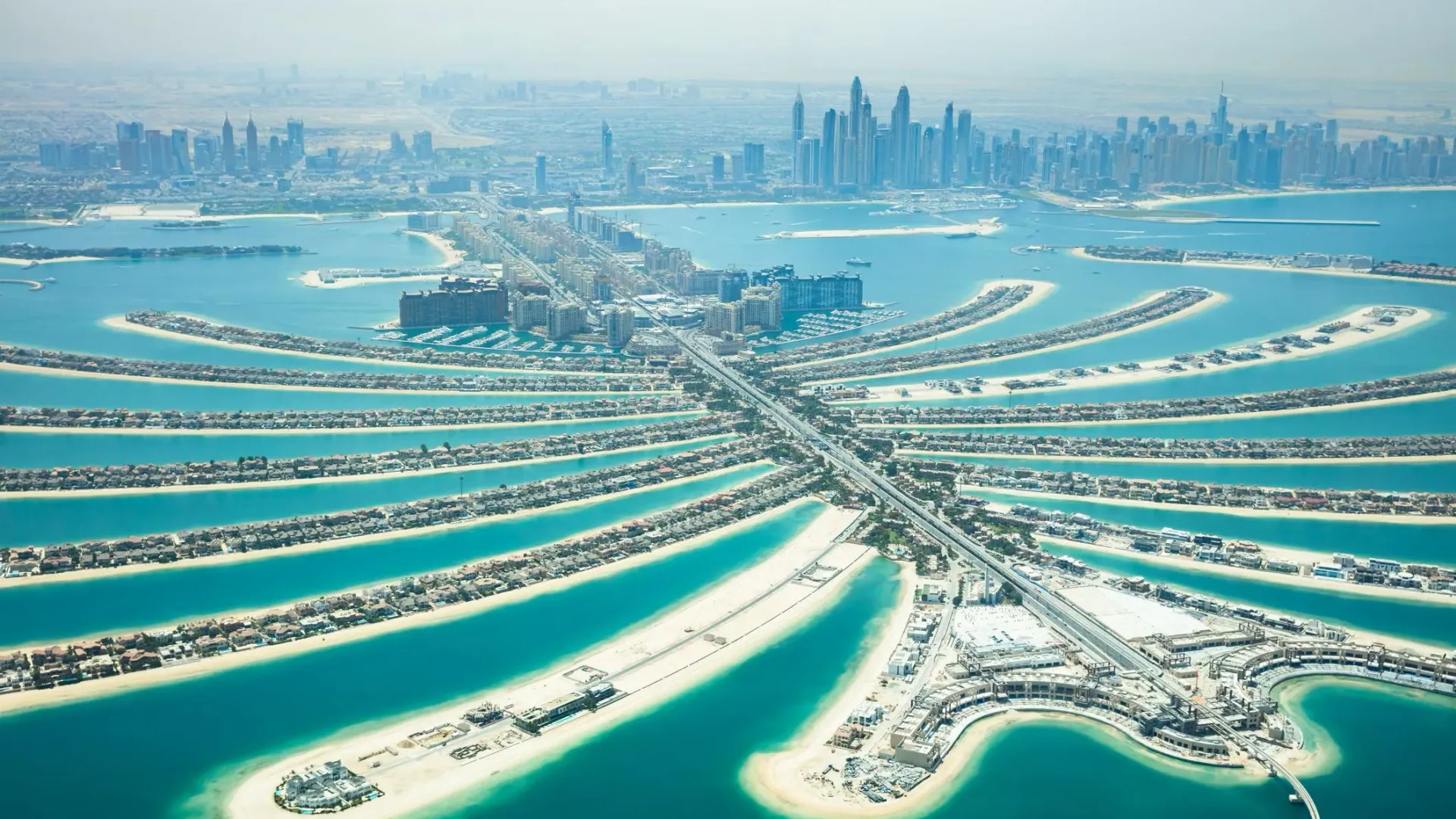
In 2026, the best family-home communities are usually the ones that combine schools, roads, parks and day-to-day convenience. Dubai Hills Estate remains one of the cleanest examples because it gives families space without pushing them too far from the city core. Arabian Ranches and Damac Hills 2 still appeal to buyers who want a more settled suburban rhythm. The Valley and Al Furjan can work for buyers who want family logic without paying prime-core pricing. In the villa segment, Palm Jumeirah and Emirates Hills sit at the top end of the market where privacy and prestige matter just as much as square footage.
This is why family homes often perform differently from apartments. A family buyer is not usually chasing the same liquidity curve as an investor. They are buying years of comfort, not a quick flip. The right home for that buyer is the one that reduces friction in daily life: school routes, commute time, guest parking, outdoor space, noise levels and future upgrade potential. That is a very different scorecard.
If you want the broader supply and population backdrop behind that shift, our H2 2026 market outlook explains why family demand is still being supported by long-term residency trends.
Where The Market Is Actually Moving In 2026
The market is not simply favouring one asset type over the other. It is rewarding the right version of each asset type. DLD said Dubai recorded AED252 billion in Q1 2026 transactions, and of that, investments reached AED173 billion across 57,744 transactions. Foreign investment value also rose to AED148.35 billion, and the investor base grew to 48,448. Those are the conditions of a mature market: more capital, more segmentation and more attention to what each buyer actually wants.
That segmentation shows up in the supply pipeline too. Khaleej Times reported that Dubai's total residential inventory stood at about 935,000 units by end-2025, with 46,700 delivered during the year. Around 55,000 units are expected in 2026 and about 75,000 in 2027. The same report said Dubai added over 208,000 new residents in the past year, a 5.2 percent increase. That means the city is still absorbing population, but it is also adding choice. Choice creates opportunity, but it also punishes lazy buying.
There is also a useful signal in the rental outlook. Khaleej Times reported that rental increases of about 4 to 6 percent are still expected in select high-demand areas in 2026, especially where supply remains constrained. At the same time, Colliers said in mid-2026 that apartment and villa sale prices eased 3 percent quarter on quarter, while apartment rents fell 4 percent and villa rents fell 2 percent. That mix tells you the market is cooling in some places while still holding up in others. Buyers need to read the micro-market, not just the macro headline.
In apartment-heavy districts, the competition is not just among buildings, but among unit sizes. In family-home districts, the competition is often between communities with schools, walkability and day-to-day convenience. That is why the same buyer can look at JVC and Dubai Hills Estate and come away with two totally different conclusions. JVC can be a cleaner apartment investor play. Dubai Hills Estate can be the better family life play. Neither is universally superior.
Another useful lens is this: the apartment market is often about net yield and tenant churn, while the family-home market is about occupancy stability and lifestyle resilience. One is not better than the other. They just solve different problems.
How To Choose The Right Playbook
Start with the holding period. If the buyer wants a shorter holding period, an apartment usually makes more sense because the ticket size is smaller and the tenant universe is broader. If the buyer wants a longer hold and sees the property as part of family life, a townhouse or villa usually deserves a closer look. The answer changes again if the buyer has children in school, plans to live in Dubai for many years or wants more control over daily comfort.
Then test the asset against the exit. Apartments should be judged on how easy they are to explain to the next buyer, how quickly they can be rented and how resilient the building is in a more selective market. Family homes should be judged on whether the community still feels practical after the novelty wears off. A villa with a nice brochure but poor road access is not a family win. An apartment with a strong address but weak tenant demand is not a great investment win. The market punishes those mismatches.
From the Agent's Desk: we often see buyers try to force one strategy into the wrong asset. Investors buy family homes for the yield and then worry about slower resale. End users buy apartments for convenience and then regret the lack of space. The better move is to decide first whether the priority is cash flow, capital growth, or quality of life, and only then choose the asset type.
If you want a quick shortlist, use this rule of thumb: apartments suit investors, family homes suit residents, and the best Dubai buyers understand when to cross over. For an apartment-led buyer brief, start at our current properties. For a family-home brief, contact Astraterra here and we will narrow the options by school access, commute time and exit logic.
Is an apartment always the better investment in Dubai?
No. Apartments are often easier to rent and sell, but some villa and townhouse communities can outperform if the supply is tighter and the family demand is stronger.
Are family homes always better for end users?
Usually, but not always. Some buyers are happier in a central, well-serviced apartment than in a larger home with a longer commute.
Which communities should I compare first?
For apartments, start with JVC, Business Bay and Dubai Marina. For family homes, start with Dubai Hills Estate, Arabian Ranches, Damac Hills 2 and Al Furjan.
What is the biggest mistake buyers make?
They buy the wrong asset type for their holding period. That is how investors end up with slow family-home exits and families end up cramped in apartments that never feel right.
How can Astraterra help?
We compare yield, service charges, school access, commute time and resale audience so the choice fits the buyer's real plan, not just the brochure.
What is the safest way to think about 2026?
Pick the asset that matches your real use case, not the one that looks best in a market headline.
About the Author: Joseph Toubia is the CEO of Astraterra Properties and a RERA-certified real estate broker in Dubai. He works with buyers, landlords and investors across apartments, family homes, off-plan launches and ready stock, using live market evidence and on-the-ground deal flow rather than generic commentary.