
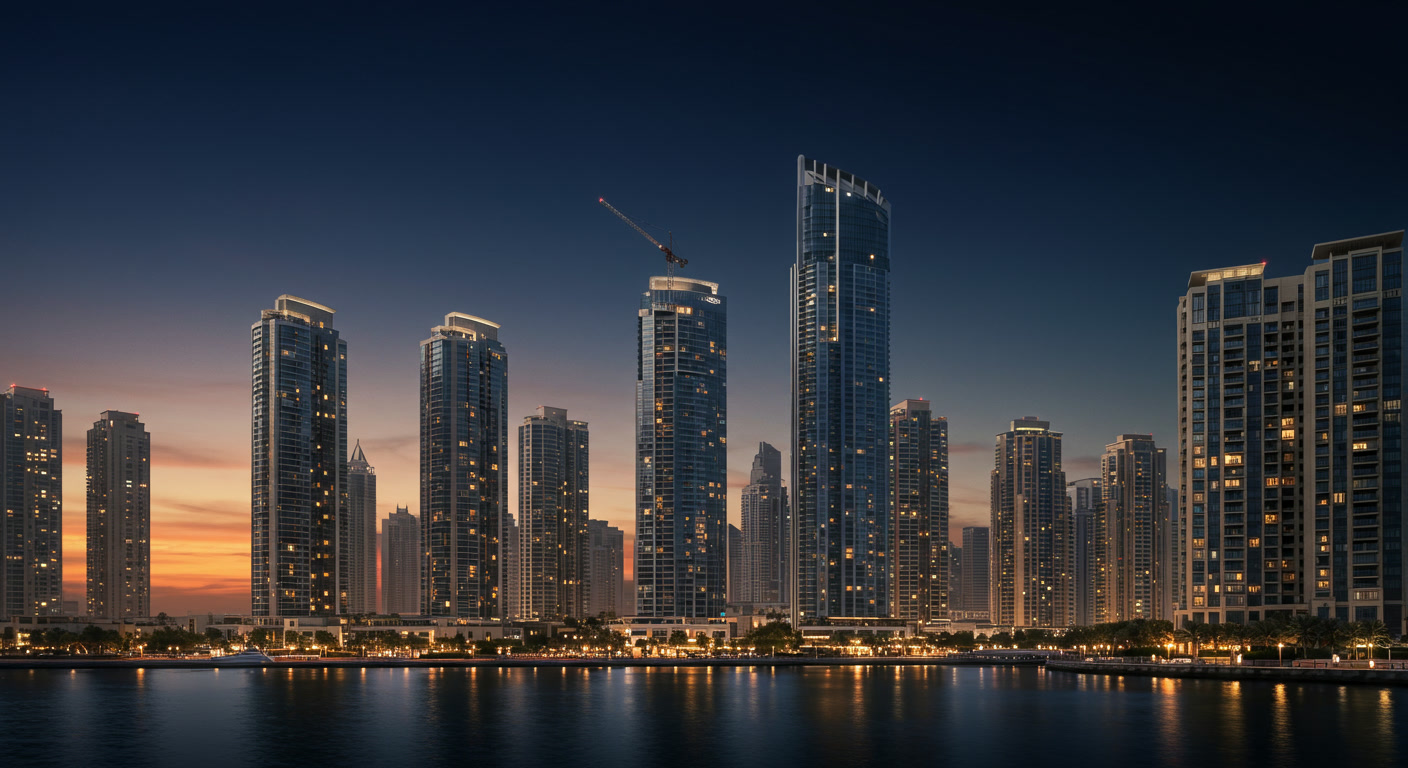
- Near-handover property in Dubai 2026 gives cautious buyers a useful middle ground between fully ready stock and long-dated off-plan exposure.
- Q1 2026 market signals still show strong liquidity, with Gulf News reporting roughly AED 176.7 billion in Dubai property sales across nearly 48,000 transactions, while off-plan remains a large share of activity.
- The safer near-handover deals are usually in proven rental corridors such as Business Bay, Dubai Hills Estate, JVC, Dubai Creek Harbour and selected MBR City projects where tenant demand is easier to underwrite.
- The main advantage is shorter execution risk, faster move-in or leasing, and better visibility on final quality than early-launch off-plan buying.
- Near-handover does not mean automatic safety. Buyers still need to pressure-test developer track record, snagging quality, service charges, payment schedule and resale competition at delivery.
- In 2026, disciplined buyers are prioritising capital preservation, rental resilience and exit clarity over hype-driven pre-handover appreciation stories.
April 25, 2026
Near-Handover Dubai Properties 2026: Lower-Risk Opportunities for Cautious Buyers
By Joseph Toubia | RERA Certified Agent | Astraterra Properties
13 min read
Quick answer
At a glance
Why near-handover property is becoming a serious 2026 strategy in Dubai
Near handover property Dubai 2026 is one of the clearest strategic lanes for cautious buyers right now. It sits in the middle ground between ready property, where you pay for full visibility and immediate occupancy, and early off-plan, where you accept more timeline and execution risk in exchange for a lower entry point. For many buyers in 2026, that middle ground is exactly where the risk-reward balance starts to make sense again.
The reason is simple. Regional uncertainty has not killed Dubai demand, but it has changed how serious buyers want to deploy capital. They want shorter duration exposure, clearer delivery visibility, less dependence on a multi-year construction story and faster access to either rental income or actual occupancy. Near-handover property answers those needs better than a glossy launch with a distant completion date.
Public and internal market signals support that shift. Gulf News reporting tracked roughly AED 176.7 billion in Dubai property sales across nearly 48,000 transactions in Q1 2026, with off-plan activity still representing around 70% of the market. Source: Gulf News market reporting referenced in Astraterra daily notes, April 2026. At the same time, Astraterra's Q1 2026 market report still frames Dubai as a liquid market with roughly +18% year-on-year transaction growth and average gross rental yields near 7.2%. Source: Astra Terra Properties, Dubai Real Estate Market Report, Q1 2026. That combination matters because it tells you buyers do not need to be reckless to find opportunity. There is enough demand and enough market depth to be selective.
What near-handover really means, and why it is different from generic off-plan
When I say near-handover, I mean projects where construction is substantially advanced, the remaining timeline is short enough to underwrite with more confidence, and the payment exposure is meaningfully compressed versus a project that is still early in the build cycle. In practical terms, that usually means the buyer can inspect real progress, compare competing delivery stock, estimate the final finish level with more accuracy and think about leasing or occupancy on a much shorter horizon.
This is not the same as buying launch-stage off-plan and hoping the market bails you out by completion. In 2026, that distinction matters. A shorter timeline reduces the number of things that can go wrong between commitment and income. It does not eliminate risk, but it narrows it. That is exactly why some cautious buyers who would not touch a 2029 completion are still willing to consider a high-quality project handing over in late 2026 or 2027.
Why this lane fits a war-mode strategy
Astraterra's current war-mode approach is not about panic. It is about discipline. We are favouring capital preservation, ready property, near-handover stock, resilient rental corridors and practical buyer decisions over narrative-heavy speculation. Near-handover fits that framework because it gives buyers a way to avoid paying full ready-stock premiums while still reducing the biggest risk factors associated with early off-plan deals.
In plain terms, it is a middle-ground strategy for buyers who still want some pricing inefficiency or developer incentive without taking the full construction-duration gamble. That is why I see rising interest from clients who previously defaulted to either fully ready stock or pure launch-phase projects. The market in 2026 is making them meet in the middle.
If you want the broader framework behind that cautious positioning, our guide on ready vs off-plan in Dubai 2026 explains why the market has started rewarding shorter-duration exposure more clearly.
Where near-handover property looks strongest in Dubai right now
Business Bay, central demand and faster leasing visibility
Business Bay remains one of the easiest districts to justify for near-handover buying because demand does not rely on one narrow tenant profile. Professionals, couples, relocators and central-city renters all support the area. According to Astraterra's Q1 2026 market report, Business Bay broadly sits around AED 2,200 to AED 2,800 per square foot with gross rental yields around 6.5% to 7.5%. Source: Astra Terra Properties, Dubai Real Estate Market Report, Q1 2026. For a buyer considering late-stage inventory, that matters because the rental logic is already visible. You do not need to invent the tenant story from scratch.
Near-handover units in stronger canal-adjacent or professionally managed towers can offer a useful compromise. You may still benefit from developer payment structure or delivery-stage pricing, but the path to rent collection is much shorter than in early-stage off-plan. In 2026, I like that because it gives investors a clearer view of how quickly the asset can start carrying itself.
Dubai Hills Estate, lower-drama end-user demand
Dubai Hills Estate is a different kind of near-handover play. The strength here is not maximum yield, but cleaner end-user demand and more stable community appeal. Q1 2026 pricing in the area broadly ranges from AED 1,600 to AED 2,200 per square foot, with gross yields around 5.5% to 7.0%. Source: Astra Terra Properties, Dubai Real Estate Market Report, Q1 2026. That profile suits buyers who care about long-term livability, family-led demand and the probability that the finished product will still be desirable when more supply arrives.
Near-handover stock in Dubai Hills can be especially interesting for buyers who want to avoid the premium attached to fully seasoned buildings while still targeting a community with strong mall, school, park and road-link fundamentals. If your goal is to preserve capital first and chase upside second, this is one of the cleaner lanes in the city.
JVC, value still works, but only with stricter quality filters
JVC is where near-handover can look attractive on paper very quickly. The area still screens around AED 900 to AED 1,400 per square foot with yields often in the 8.0% to 10.0% range. Source: Astra Terra Properties, Dubai Real Estate Market Report, Q1 2026. Add to that Astraterra's weekly intelligence note that studios and one-beds in JVC can still show roughly 8.0% to 9.2% net rental yields in stronger pockets, and you can see why buyers keep coming back. Source: Astraterra weekly market update, March 2026.
But JVC is also where discipline matters most. Near-handover here only works if the building quality, parking, access, finishing and management setup are genuinely strong. The quality spread inside JVC remains wide. Some late-stage projects may look appealing on payment plan, then disappoint at delivery. Others can become solid cash-flow assets if the building actually performs. In 2026, JVC is not a blind-buy district. It is a filter-heavy district.
Buyers who are comparing value-led communities should also review our stable rental demand guide because the best near-handover deal is usually the one with the strongest tenant depth after delivery, not the one with the loudest pre-handover sales pitch.
Dubai Creek Harbour and MBR City, interesting if the handover story is genuinely visible
Dubai Creek Harbour and selected parts of MBR City remain interesting for near-handover buyers because they combine master-plan credibility with a still-evolving price story. These are not purely speculative districts anymore, but buyers still need to separate mature sub-locations from future-promise marketing. The better near-handover opportunities tend to be in projects where surrounding infrastructure, retail activation and community shape are already visible enough to support actual occupancy, not just brochure optimism.
In these districts, my main question is not whether the area is good in theory. It is whether the delivery window is close enough, and the surrounding environment real enough, that a tenant or end user would comfortably choose it soon after handover. If the answer is yes, the near-handover angle can be compelling. If the area still feels too dependent on future phases, then the risk profile starts behaving more like ordinary off-plan again.
The practical market reason near-handover matters now
Astraterra's internal weekly campaign notes also flagged a pipeline of over 12,000 units expected for handover across major developers in a 2026 window. Source: Astraterra weekly market update, March 2026. That kind of pipeline matters because it creates both opportunity and competition. Buyers can often find more realistic delivery-stage pricing, but they also need to think ahead about how many similar units will hit the market at once. The best near-handover buys are not just close to completion. They are positioned to survive delivery-week competition without losing rentability or resale appeal.
How to underwrite near-handover deals without getting trapped by the last sales pitch
Check delivery risk, not just delivery date
A handover date on a brochure is not the same thing as genuine delivery confidence. Buyers should look at current construction progress, developer track record, finishing consistency in past projects, expected snagging intensity and the real likelihood of phased delays. In 2026, I would rather buy from a developer with a boring but consistent delivery history than from a flashy one with weaker execution discipline.
The biggest mistake buyers make with near-handover stock is assuming that because the project is close, the risk is minimal. That is not always true. Final-stage execution matters. Snagging quality matters. Service-charge structure matters. Post-delivery competition matters. A project can be 90% built and still disappoint as an investment if those factors are ignored.
Model the first 12 months after handover conservatively
For investors, the right way to think about near-handover property in Dubai 2026 is to build a conservative first-year model. Assume some lease-up time, some furnishing or snagging cost, some initial competition from other freshly delivered stock and realistic service charges. If the deal still makes sense after those deductions, the opportunity is real. If it only works under a perfect-ramp scenario, it is probably too fragile for a cautious buyer.
Joseph's Take, when I review near-handover deals for clients, I am not trying to prove the purchase works. I am trying to break the case. If the numbers, location logic and building quality still hold after stress-testing, then the deal starts to earn trust. That is the mindset cautious buyers need in 2026.
The contrarian point, near-handover is not automatically safer than ready property
There is a temptation to present near-handover as a perfect compromise. I would not go that far. In some situations, fully ready property is still the safer choice because you can inspect the exact unit, understand the service-charge reality and lease it immediately. Near-handover becomes attractive when the pricing gap versus ready stock is meaningful enough, and the remaining uncertainty is small enough, to justify the trade.
That is why some buyers should still choose ready property. Others should choose near-handover. The right answer depends on whether you value inspection certainty more than potential pricing advantage. What I would avoid in 2026 is long-dated speculative exposure unless the buyer has very high conviction, strong liquidity and a clear appetite for timeline risk.
Who near-handover property suits best in 2026
Near-handover usually suits three types of buyers best. First, the investor who wants rental income soon, but is still willing to accept a short wait if the pricing is more attractive than fully ready stock. Second, the end user who is planning a move or relocation within the next year and wants some flexibility without paying the full premium for immediately occupied inventory. Third, the cautious international buyer who wants exposure to Dubai, but prefers a shorter-duration entry point while the market remains selective.
It is less suitable for buyers who need immediate occupancy, buyers who cannot tolerate even modest snagging or timeline uncertainty, or buyers who are secretly chasing quick-flip gains and dressing it up as a low-risk strategy. Near-handover can be disciplined. It should not be romanticised.
Joseph's Take
If a client asked me where I see the cleanest middle-ground opportunities in Dubai today, I would say near-handover deserves serious attention, but only in areas with obvious renter or end-user depth and only in projects where the final execution looks credible. I like it most when the buyer can point to a short remaining timeline, visible construction progress, defendable pricing versus ready stock and a realistic leasing case within months of delivery. When those four things line up, the strategy is strong.
I am also happy to say no. Some near-handover deals are simply the last chapter of an over-sold launch story. If the project is crowded, the finish risk is high, the service charges look heavy or too many similar units will flood the market at delivery, I would rather move the client into proven ready stock. In 2026, caution is not weakness. It is an edge.
Disclaimer: This content is for informational purposes only and does not constitute financial, investment, or legal advice. Prices and market references reflect Q1 2026 source material and internal market analysis available at the time of writing.
Frequently asked questions
What is near handover property in Dubai?
It usually refers to projects in advanced construction stages where delivery is relatively close, giving buyers more visibility on completion, quality and likely occupancy timing than early-stage off-plan.
Is near-handover property safer than off-plan in Dubai in 2026?
Usually yes, because the remaining execution timeline is shorter and the product is easier to assess. But it is still not as certain as fully ready property, so developer quality and delivery-stage competition still matter.
Which areas are best for near handover property Dubai 2026?
Business Bay, Dubai Hills Estate, selected JVC buildings, Dubai Creek Harbour and parts of MBR City are among the more practical zones, depending on project quality and handover visibility.
Can I get rental income quickly from near-handover property?
Often yes, especially compared with early off-plan, but buyers should still model snagging, furnishing, lease-up time and delivery competition rather than assuming instant occupancy.
What risks should cautious buyers still watch?
Final delivery delays, snagging quality, inflated service charges, over-supplied delivery windows, weak building management and developer promises that do not match the finished product.
Is ready property still better for some buyers?
Absolutely. Ready property is often better for buyers who want immediate occupancy, full unit inspection and the highest level of certainty on what they are actually buying.
Does near-handover help with capital preservation?
It can, because it shortens the period of uncertainty versus long-dated off-plan while sometimes avoiding the full premium attached to seasoned ready stock. But it only works if the project is chosen carefully.
References and sources
Gulf News Dubai property market reporting cited in Astraterra internal notes, April 2026; Astra Terra Properties Dubai Real Estate Market Report Q1 2026; Astraterra weekly market update, March 2026; supporting market context from DLD, Bayut, Property Finder, CBRE and JLL workflows referenced across internal research.
Want a safer shortlist of near-handover options in Dubai?
Talk to Joseph Toubia at Astra Terra Properties for a practical review of delivery risk, service charges, rental outlook and exit quality before you commit.
📞 +971 58 558 0053 | 🌐 Astra Terra Properties | Oxford Tower, Office 502, Business Bay, Dubai
FAQ — Dubai Property Investor Questions
Is now a good time to buy in Dubai?
For selective buyers, yes. Focus on assets with rental depth, realistic pricing, and resale liquidity.
Which is better right now: ready or off-plan?
Ready and near-handover typically offer clearer risk control and faster income visibility in the current cycle.
How do I avoid weak deals?
Underwrite net yield after service charges, compare building-level comps, and buy with an exit plan.
Area-Specific Intent: Where This Strategy Fits Best
- Business Bay: strong tenant depth, active resale market, central connectivity.
- Dubai Marina: premium rental demand, liquidity in proven towers, selective entry needed.
- JVC: attractive yield profile and broad renter pool for value-focused investors.
- Downtown Dubai: prime demand and prestige-driven occupancy, quality/price discipline required.
Explore area breakdowns: https://www.astraterra.ae/area-guides
Get Your Dubai Investment Shortlist in 24 Hours
Tell us your budget, target yield, and risk level. Astraterra will send handpicked live options with ROI logic and negotiation guidance.
- WhatsApp direct: +971 58 558 0053
- Email: joseph@astraterra.ae
- Best for: Investors, end-users, and relocation buyers
Frequently Asked Questions
J
Joseph Toubia
CEO & Founder, Astra Terra Properties
RERA-certified real estate professional (BRN 54738) specialising in Dubai off-plan properties, investment advisory, and Golden Visa guidance. Based in Dubai.
Send your requirements to Astraterra CRM
Get a qualified commercial shortlist
Share your rent or buy intent, business activity, target area, budget, size, fit-out needs, permissions and timeline. Astraterra will route it into CRM for follow-up.
Ready to Invest in Dubai Property?
Compare off-plan project details, payment schedules and handover terms, or explore ready properties for sale across Dubai.