← Back to Blogs
January 22, 2026

The Evolving Reality of Mid-Tier Retail in Dubai's Secondary Mall Market: A 2026 Analysis

By Joseph Toubia | RERA Certified Agent | Astra Terra Properties
The Evolving Reality of Mid-Tier Retail in Dubai's Secondary Mall Market: A 2026 Analysis
Section image

Dubai's retail landscape in 2026 presents a tale of diverging fortunes. While headline statistics celebrate record-breaking visitor numbers and strong overall occupancy rates, a closer examination reveals significant challenges facing a specific segment: mid-tier apparel retailers in secondary mall locations. This analysis explores the structural forces reshaping this market segment and provides strategic insights for investors and retailers navigating these evolving conditions.


Understanding Dubai's Retail Dichotomy


The Premium Tier Success Story


Dubai's flagship retail destinations continue their impressive performance trajectory. The Dubai Mall welcomed 111 million visitors in 2024, cementing its position as one of the world's most visited retail and entertainment destinations. Fashion Avenue, the mall's luxury retail extension, ranks 11th globally for retail rents according to Cushman & Wakefield's 2025 Main Streets Across the World report, with rates reaching AED 7,500-10,500 per square meter annually.


Prime locations like Mall of the Emirates and Dubai Festival City maintain occupancy rates consistently above 95%, with waiting lists for premium retail spaces. These flagship properties benefit from Dubai's robust tourism sector, which attracted 18.7 million international visitors in 2024, alongside the emirate's growing affluent resident population.


The Overall Market Appears Healthy

Aggregate statistics paint an optimistic picture. Overall retail vacancy in Dubai fell to under 5% in 2025, down from 9% in Q3 2024, according to market reports from commercial real estate firms. New supply has been absorbed efficiently, and rental rates have shown steady year-over-year increases in prime locations.


The Hidden Challenge: The Middle Market Squeeze

However, beneath these positive headlines lies a more complex reality for certain retail segments. Industry sources and retail intelligence platforms indicate that mid-tier apparel retailers brands targeting mainstream consumers with products typically priced between AED 200-800 face considerably different market dynamics in secondary and tertiary mall locations.


While precise vacancy statistics for this specific segment are difficult to obtain publicly, conversations with retail operators, property managers, and industry consultants suggest that these retailers experience notably higher turnover and vacancy rates compared to the overall market average. Some industry observers estimate challenges in the double-digit percentage range for this particular category in non-prime locations.


Structural Forces Reshaping Mid-Tier Retail


1. The E-Commerce Transformation

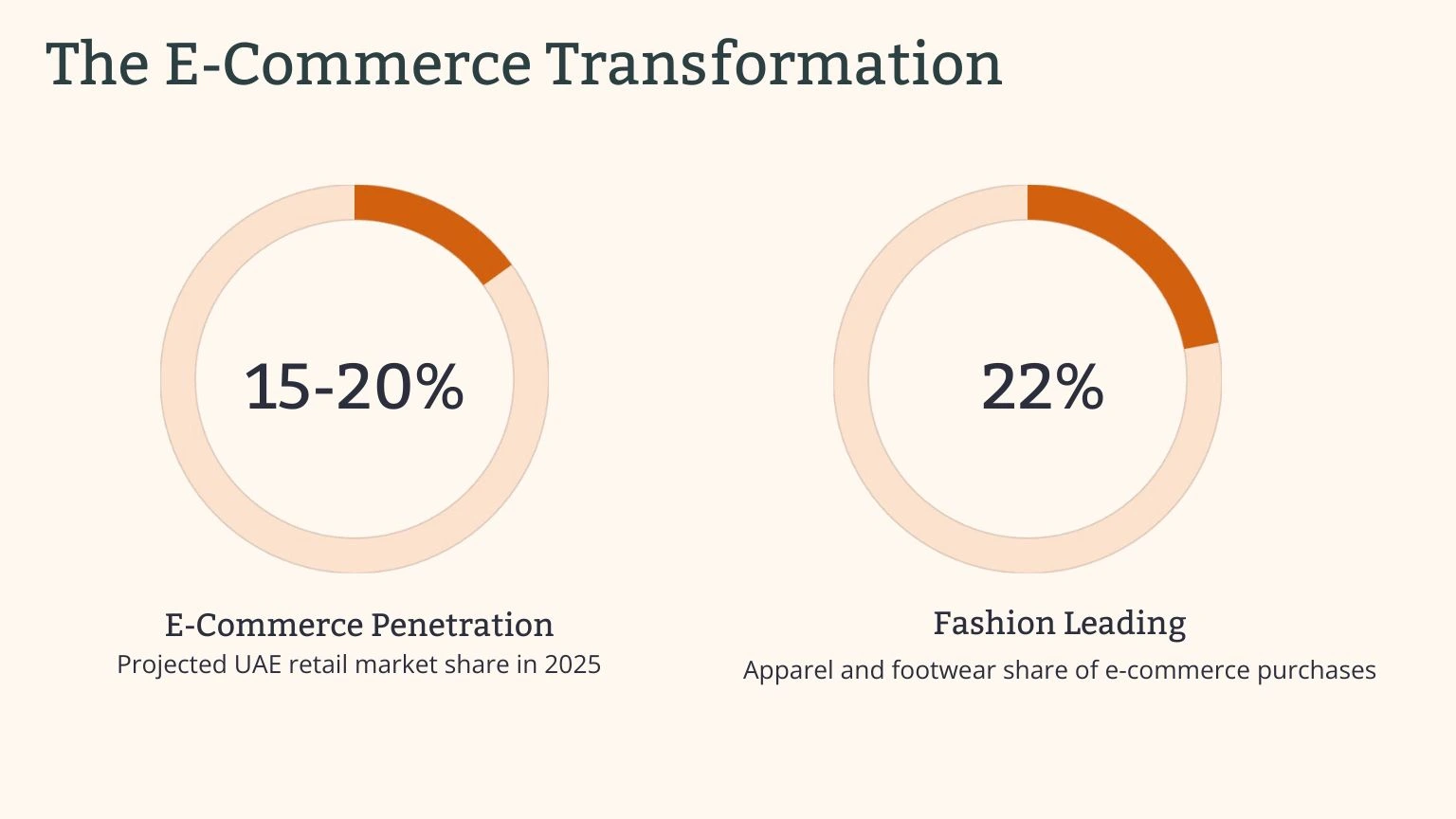
The UAE's digital retail revolution has fundamentally altered consumer behavior. E-commerce penetration in the UAE retail market reached approximately 10-15% in 2024, with projections suggesting growth to 15-20% in 2025, according to industry research from firms like Mordor Intelligence and Digital Commerce 360.

Fashion leads this digital shift. Apparel and footwear account for approximately 22% of e-commerce purchases in the UAE, making it one of the most disrupted retail categories. The impact is particularly pronounced for mid-tier brands because:


  • Price transparency: Consumers can instantly compare prices across multiple retailers
  • Convenience advantage: Home delivery eliminates the need to visit physical locations
  • Try-at-home options: Flexible return policies reduce purchase risk
  • Digital-native competition: Online-only brands operate without physical retail costs

For mid-tier apparel specifically, the value proposition of visiting a secondary mall location has weakened considerably. When similar products are available online with free delivery within 24-48 hours, the traditional retail model faces fundamental challenges.

2. Market Polarization and Consumer Behavior

2. Market Polarization and Consumer Behavior

Dubai's consumer market is experiencing increasing polarization in shopping behavior:


The Premium Segment: Affluent residents and tourists seek luxury experiences at flagship destinations. These shoppers value the experiential elements of ambiance, service, exclusivity, and social prestige that justify visits to Dubai Mall, Mall of the Emirates, or the upcoming Dubai Square.

The Convenience Segment: Time-constrained consumers prioritize neighborhood accessibility. Community malls in areas like Al Barsha, Motor City, JBR, and Arabian Ranches serve residents seeking everyday needs within a 5-10 minute drive. Lower rental costs in these locations (typically AED 1,200-2,500 per square meter annually) enable sustainable economics for value-oriented retailers and essential services.

The Challenged Middle Ground: Mid-tier retailers in secondary super-regional malls capture neither segment effectively. These locations lack both the destination appeal of flagship malls and the convenience advantage of neighborhood centers. With over 80 malls operating across Dubai, the middle market faces structural oversupply.


3. The Geographic Disadvantage

Secondary malls typically those ranking below the top 5-7 destinations face inherent location challenges:


  • Not a destination: Unlike Dubai Mall or Mall of the Emirates, they don't attract tourists or cross-city visitors
  • Not convenient: Located farther from residential clusters than community malls
  • Not differentiated: Limited unique offerings compared to competitors or online options

When a consumer can purchase similar mid-tier apparel online or at a community mall 5 minutes away, the motivation to drive 15-20 minutes to a secondary location diminishes significantly.


The Economic Reality: Understanding Occupancy Costs

Even in secondary locations, retail occupancy costs remain substantial in Dubai's market. Retailers face multiple cost layers:


Cost Structure Breakdown

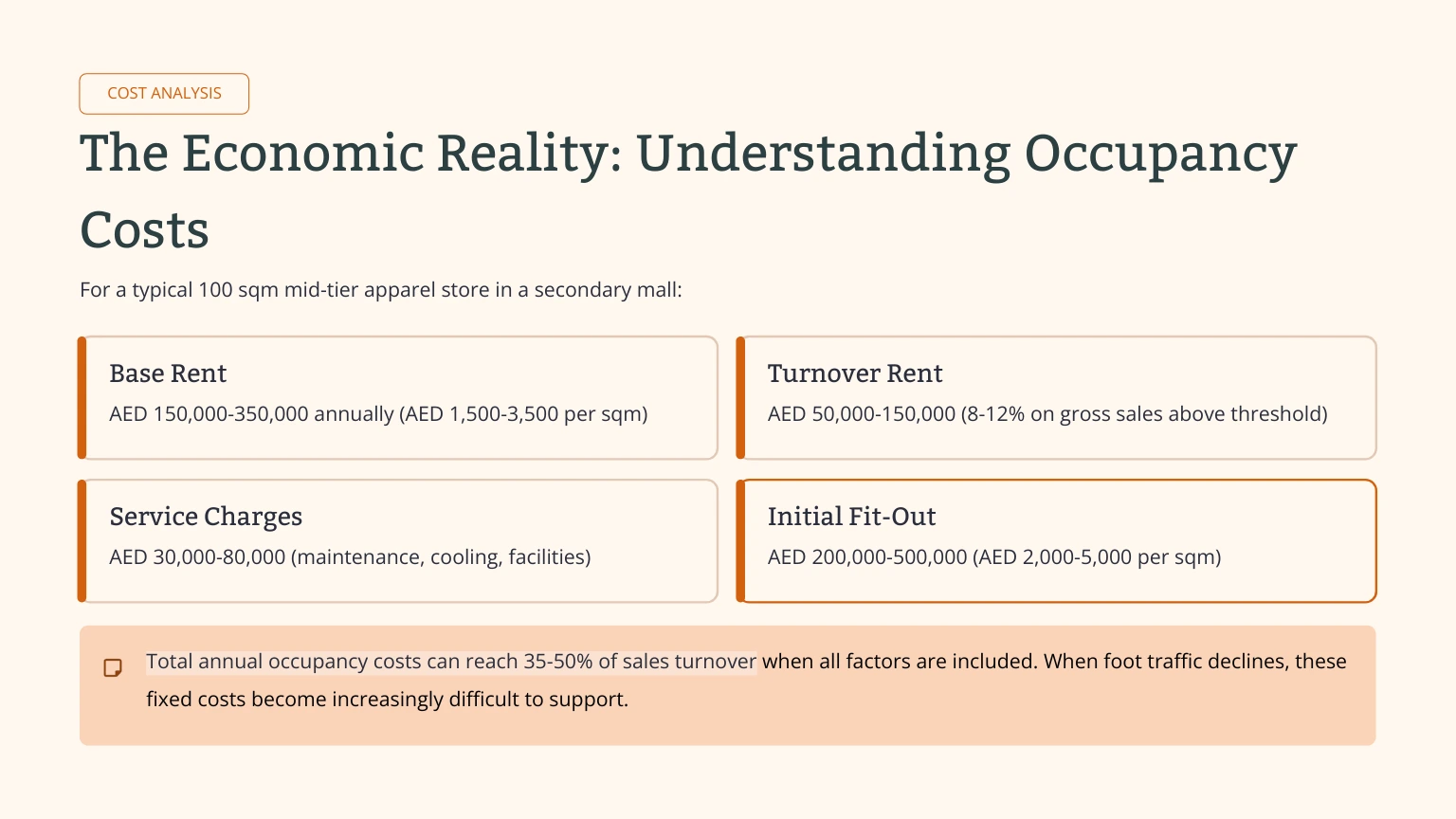
Base Rent: Secondary mall locations typically command AED 1,500-3,500 per square meter annually, depending on specific location, floor level, and negotiated terms. Community malls may offer lower rates (AED 1,200-2,500 per sqm), while prime locations can exceed AED 7,500 per sqm.

Turnover Rent: Most leases include percentage rent provisions of 8-12% on gross sales above a negotiated threshold.

Service Charges: Common area maintenance, cooling, and facility fees add to occupancy costs.

Fit-Out Investment: Initial store construction and design costs range from AED 2,000-5,000 per square meter, representing significant upfront capital.


The Profitability Challenge

For a typical 100 square meter mid-tier apparel store in a secondary mall:


  • Annual base rent: AED 150,000-350,000
  • Turnover rent: Variable, potentially AED 50,000-150,000 depending on sales
  • Service charges: AED 30,000-80,000
  • Initial fit-out: AED 200,000-500,000

Total annual occupancy costs can reach 35-50% of sales turnover when all factors are included. When foot traffic declines due to e-commerce competition and location disadvantages, these fixed costs become increasingly difficult to support.

Looking for Dubai property advice?

Get a free consultation from our RERA-certified team

💬 WhatsApp Us — Free Consultation

What's Thriving in 2026: Success Patterns

Understanding what succeeds provides insight into viable strategies:


Ultra-Prime Locations

Luxury and premium brands in flagship malls continue reporting strong performance. Industry sources indicate many luxury retailers experienced approximately 20% sales growth in 2024, driven by tourist spending and high-net-worth resident demand. These locations justify premium rents through exceptional foot traffic, international brand exposure, and affluent customer demographics.


Community-Focused Retail

Neighborhood malls serving growing residential areas demonstrate consistent occupancy success. These locations benefit from:


  • Captive local demand: Residents seeking convenience for daily needs
  • Lower rental costs: More sustainable economics for tenants
  • Reduced competition: Serving defined geographic catchments
  • Essential services focus: Supermarkets, pharmacies, services, and F&B

Dubai's population growth approximately 3.5% annually according to various estimates continues supporting well-located community retail.


Experience-Driven Categories

Food & beverage, entertainment, beauty services, and wellness concepts consistently outperform traditional retail. These categories offer experiences that e-commerce cannot replicate:


  • Immediate gratification: Dining and entertainment are inherently physical
  • Social experiences: Gatherings and activities that create memories
  • Service components: Personalized attention and expertise
  • Sensory engagement: Taste, atmosphere, and live interactions

Savvy mall operators increasingly allocate space toward these categories while reducing traditional retail footprints.


Strategic Considerations for Retailers and Investors


Based on current market dynamics, several strategic approaches merit consideration:


For Mid-Tier Apparel Retailers


1. Reconsider Secondary Super-Regional Locations

Unless negotiating exceptional terms extended rent-free periods (6-12 months), substantial fit-out contributions, flexible exit clauses, and below-market rental rates carefully evaluate whether secondary mall locations align with your business model. The structural headwinds may outweigh location benefits.


2. Embrace Omnichannel Integration

Physical retail must complement digital channels rather than compete with them. Consider:


  • Treating stores as brand showrooms and experience centers
  • Accepting that 40-60% of sales may occur online
  • Reducing physical footprint to optimize economics
  • Integrating inventory systems for click-and-collect
  • Training staff to support digital journeys


3. Target Community Mall Opportunities

Growing residential areas with new community malls offer more favorable economics:


  • Lower rental costs improve profitability thresholds
  • Convenience-driven traffic is less discretionary
  • Reduced competition from online alternatives
  • Sustainable long-term demand from population growth


4. Create Differentiated In-Store Experiences

If operating in secondary malls, justify customer visits through unique experiences:


  • Personal styling and consultation services
  • Exclusive in-store product collections
  • Events, workshops, and community engagement
  • Complementary services (alterations, customization)
  • Elevated customer service that online cannot match


For Real Estate Investors


1. Recognize Format Differentiation


Not all retail real estate performs equally. Success increasingly depends on clear positioning:


  • Flagship destinations: Require scale, tourist appeal, and experiential elements
  • Community convenience: Serve defined residential catchments efficiently
  • Specialty/lifestyle centers: Offer unique positioning (outlet, luxury, thematic)

Generic secondary super-regional malls without clear differentiation face the most challenging outlook.


2. Tenant Mix Evolution

Forward-thinking mall operators are shifting tenant mix toward less e-commerce-vulnerable categories:


  • Increasing F&B allocation from 15-20% to 25-35% of GLA
  • Adding entertainment and leisure concepts
  • Emphasizing services over goods retail
  • Curating unique concepts unavailable elsewhere


3. Realistic Underwriting

When evaluating retail investments, particularly in secondary locations:


  • Model realistic vacancy assumptions for vulnerable categories
  • Stress-test against continued e-commerce growth
  • Evaluate location convenience and catchment strength
  • Assess differentiation versus competing centers
  • Consider tenant rollover and leasing costs


Looking Ahead: The 2026-2027 Outlook


Several trends will likely shape Dubai's retail landscape in the near term:


Tourism Momentum Continues

Dubai's tourism sector maintains strong fundamentals. While specific numerical targets for 2026 vary across sources, continued growth in international visitor arrivals appears likely given infrastructure investments, event calendars, and global tourism recovery trends.


E-Commerce Maturation

Digital retail penetration will continue expanding, potentially reaching 15-20% of total retail sales by end-2025 or early 2026. Fashion and electronics will remain leading online categories, further pressuring traditional apparel retail models.


Market Consolidation Expected


The structural challenges facing mid-tier retailers in secondary locations suggest continued market adjustment. This may manifest as:


  • Selective store closures in underperforming locations
  • Lease renegotiations with more favorable tenant terms
  • Increased turnover in vulnerable retail categories
  • Landlords offering greater concessions to maintain occupancy


New Supply on the Horizon

Major projects like Dubai Square (2028+ opening) will add substantial new retail inventory to the market. While these flagship developments may succeed individually, they will increase competitive pressure on existing secondary properties.


Successful Adaptation Required

Retailers and landlords demonstrating adaptability will likely outperform:


  • Retailers: Those integrating digital and physical seamlessly
  • Landlords: Those curating differentiated, experience-focused tenant mixes
  • Both: Those recognizing and responding to structural market changes


Conclusion: Navigating the New Retail Reality


Dubai's retail market in 2026 reflects broader global trends: the flight to quality, digital disruption, and experience-driven consumption. While aggregate statistics suggest market health, significant variation exists across segments and formats.

Mid-tier apparel retailers face genuine structural challenges in secondary mall locations, challenges unlikely to resolve through economic cycles alone. The combination of e-commerce convenience, market polarization, location disadvantages, and substantial occupancy costs creates difficult operating conditions.


Success in this environment requires honest assessment of these realities and strategic adaptation:


  • Retailers must embrace omnichannel models, seek favorable locations, and create compelling reasons for physical visits
  • Investors must differentiate between retail formats, recognize vulnerable segments, and underwrite conservatively
  • Developers must curate distinctive, experience-focused destinations rather than generic retail collections

The future belongs to those who recognize that retail real estate is no longer primarily about providing space for transactions; it's about creating destinations, experiences, and communities that complement rather than compete with digital alternatives.


About Astra Terra Properties


Astra Terra Properties is a Dubai-based real estate advisory firm specializing in luxury residential and commercial property markets. Our commercial division provides institutional investors, retailers, and developers with data-driven insights and strategic advisory services across the GCC region.


This analysis represents our assessment of current market conditions based on publicly available information, industry research, and professional experience. It should not be considered financial advice or a substitute for professional consultation.


Sources and References


This analysis incorporates publicly available information from:


  1. Cushman & Wakefield - "Main Streets Across the World, 35th Edition" (2025)
  2. Various commercial real estate research reports on Dubai retail market (2024-2025)
  3. Mordor Intelligence - "UAE E-commerce Market Industry Report" (2024-2025)
  4. Digital Commerce 360 - UAE e-commerce market analysis
  5. Dubai Department of Economy and Tourism - Tourism statistics
  6. Industry publications and market reports from recognized commercial real estate firms
  7. Third-party retail intelligence platforms and market data providers


All statistics and data points represent estimates and projections based on available information as of January 2026. Market conditions are subject to change.


For inquiries regarding Dubai commercial real estate opportunities:

📧 commercial@astraterra.ae

📱 +971 58 558 0053

🌐 www.astraterra.ae

Frequently Asked Questions: Mid-Tier Retail in Dubai 2026

Q1: Are secondary malls in Dubai still profitable for retailers in 2026?
Yes, but selectively. Secondary malls anchored by strong community demographics — high residential density, limited competing retail, established foot traffic from gyms, supermarkets, and F&B — continue to perform well. Malls in JVC, Al Barsha, and Discovery Gardens maintain 85–92% occupancy rates (CBRE Retail Market Report Q4 2025). Malls that lack a compelling anchor tenant or community catchment are struggling with occupancy below 70%.

Q2: What are typical retail lease rates in Dubai's secondary malls?
Ground floor retail in secondary community malls typically ranges AED 150–350 per sqft annually, compared to AED 500–1,200+ per sqft in primary malls like Dubai Mall or Mall of the Emirates. Service charges add AED 30–80 per sqft depending on the mall's amenity level. For F&B units with kitchen extraction requirements, landlords increasingly demand fit-out contributions in lieu of rent-free periods.

Q3: How has e-commerce affected Dubai's secondary retail market?
E-commerce penetration in the UAE reached 15.3% of total retail sales in 2025 (Euromonitor International), with grocery and electronics most impacted. However, experiential categories — F&B, fitness, beauty services, and speciality retail — have proven e-commerce-resistant and are driving the strongest demand for secondary mall space. The shift is structural: commodity retail is migrating online while experience-led retail is capturing physical space.

Q4: What lease terms should commercial tenants negotiate in 2026?
In the current market, tenants have more leverage than they did in 2022-2023. Focus on: (1) A minimum 3-year initial term with 2-year renewal options at capped increases; (2) Turnover rent clauses on years 2-3 to share risk; (3) Fit-out periods of 60-90 days rent-free; (4) Break clauses at year 2 if sales targets are not met; (5) Right of first refusal on adjacent units. Landlords in secondary malls are increasingly willing to negotiate on all five points.

Q5: Is it better to buy or lease retail space in Dubai's secondary malls?
For established businesses with 5+ years of proven Dubai trading history, purchasing strata-titled retail units in secondary malls can offer a compelling AED cost structure — prices range AED 1,200–2,800 per sqft in community retail centres. Gross rental yields on purchased retail units range 7–10% in mid-tier locations. For new entrants testing a concept, leasing is lower risk. See our guide to retail business costs in Dubai for a full breakdown.

Sources & References

  • CBRE Dubai Retail Market Report Q4 2025
  • Knight Frank UAE Commercial Property Outlook 2026
  • Dubai Land Department (DLD) — Commercial Transactions Data 2025
  • Euromonitor International — UAE E-Commerce Penetration Report 2025
  • JLL Dubai Retail Occupancy Survey Q3 2025

Joseph's Take: The Hidden Opportunity in Dubai's Secondary Retail Market

The narrative around secondary malls in Dubai is more nuanced than the headlines suggest. Yes, some malls are struggling. But I've watched community retail centres in JVC, Jumeirah, and Al Barsha maintain near-full occupancy through every market cycle, and those properties continue to attract serious commercial investors precisely because their tenant mix is built on necessity — pharmacies, medical clinics, supermarkets, F&B — not discretionary luxury.

The opportunity I'm seeing in 2026 is in mid-market F&B concepts targeting Dubai's expanding professional and family residential base. The communities being developed today — Expo City, Dubai South, and the JVC expansion — are creating demand for quality casual dining and speciality food that existing secondary malls are not yet serving well. First-mover advantage in these emerging catchments can be significant for the right operator.

For commercial property investors, I'd direct attention to community-anchored retail strips — not malls — in established residential communities like Mirdif, Jumeirah Village Triangle, and Remraam. Strip retail in these areas transacts at AED 1,000–1,800 per sqft with net yields of 8–10%, supported by captive residential demand that is genuinely sticky. If you're evaluating commercial investment opportunities in Dubai, speak with me at +971 58 558 0053 or astraterra.ae/contact

Frequently Asked Questions

Frequently Asked Questions: Dubai Retail Market 2026

Is retail property a good investment in Dubai in 2026?

Dubai retail property investment has two distinct segments: prime mall space (Dubai Mall, Mall of the Emirates) which is tightly held and rarely transacts; and secondary/community retail which offers higher availability and more accessible pricing. Secondary community retail in growth areas (JVC, Al Furjan, Town Square) offers gross yields of 7–10%, driven by growing captive residential populations. Mall-style secondary retail carries higher void risk as e-commerce grows. The best opportunities in 2026 are neighbourhood convenience retail in under-served growing communities.

What is the vacancy rate in Dubai's secondary malls in 2026?

Vacancy rates in Dubai secondary malls have been rising, with some suburban malls reporting 20–40% vacancy. This contrasts with Dubai's prime malls (Dubai Mall, Mall of the Emirates, City Walk) which maintain near-full occupancy. The mid-tier segment is under pressure from: e-commerce growth; international brand consolidation to prime locations; community retail outcompeting secondary malls on convenience; and overbuilding in specific corridors. Landlords in secondary malls are increasingly offering flexible lease terms and fit-out contributions to attract tenants.

What are the most resilient retail categories in Dubai's secondary mall market?

Resilient categories in Dubai secondary malls include: food & beverage (particularly quick-service restaurants and casual dining), health & fitness (gyms, yoga studios), essential services (pharmacy, clinic, bank branch), children's education (nurseries, tutoring centres), and beauty services (salons, barbers, spas). These service-oriented categories are not replaceable by e-commerce and benefit from physical proximity to residential catchments. Pure product retail (clothing, electronics) has suffered most from online competition and brand consolidation.

How do retail leases work in Dubai for commercial tenants?

Dubai commercial retail leases are governed by the same RERA tenancy framework as residential, but with more flexible terms. Typical retail leases in malls and community retail: 1–5 year initial term (mall leases often 3–5 years with option to renew); rent reviews typically annual or every 2 years; DLD Ejari registration mandatory; security deposit typically 1–3 months' rent; fit-out allowances negotiable (particularly in high-vacancy secondary malls where landlords compete for tenants). VAT at 5% is applicable on commercial rents.

What are the legal protections for commercial tenants in Dubai malls?

Commercial tenants in Dubai have similar protections to residential tenants under the rental dispute framework, but mall leases often include landlord-favourable terms (e.g., turnover rent clauses, opening hours obligations, brand standards requirements). RERA's Rental Dispute Centre handles commercial disputes. Key protections: landlords cannot raise rent during an active lease; minimum 90-day notice required for non-renewal; eviction only with legal grounds and proper notice. Unlike residential, commercial tenants may have less leverage in premium mall locations where demand exceeds supply.

Which Dubai areas have the best community retail investment potential in 2026?

High-potential community retail investment locations in 2026 include: JVC (Circle Mall expansion, growing residential base); Al Furjan (metro connectivity improving retail draw); Town Square (large captive community, under-served retail); Meydan / MBR City (new master-planned area, retail infrastructure still developing); Dubai South / Expo City (long-term transformation play); and Jumeirah Garden City (major new masterplan adjacent to Trade Centre area). The pattern is communities with residential growth that have lagged on retail infrastructure.

Is it possible to buy retail units in Dubai rather than leasing?

Yes — freehold retail units are available in many Dubai communities, particularly in mixed-use towers and community centres. Investors can purchase retail units starting from AED 500,000 for small shops in JVC or Al Furjan up to AED 10M+ for prime street retail in Downtown or Dubai Marina. Retail freehold investment in Dubai is typically lower-yield than residential but offers long lease security and inflation protection. RERA governs all retail sales and transfers — ensure any retail unit purchase involves full DLD title registration.

🌍 Investing in Dubai from Abroad?

We help international investors navigate Dubai's off-plan market. Free video consultation with Joseph Toubia, RERA licensed broker (BRN 54738).

WhatsApp: +971 58 558 0053

Frequently Asked Questions

J

Joseph Toubia

Founder & CEO | RERA Certified Agent | Astra Terra Properties

Joseph Toubia is the founder and CEO of Astra Terra Properties, a full-service real estate agency headquartered in Business Bay, Dubai. With years of hands-on experience in the Dubai property market and RERA certification, Joseph specialises in helping buyers, investors, and tenants navigate the UAE real estate landscape with confidence.

📞 +971 58 558 0053✉️ info@astraterra.ae🌐 View Profile💬 WhatsApp Joseph

Ready to Invest in Dubai Property?

Browse our curated selection of off-plan projects with flexible payment plans from 10% down, or explore ready properties for sale across Dubai.

Browse Off-Plan Projects →Buy Ready Property →
Get Free Consultation